
After being hit by a commercial truck, the size of the truck, the damage to your vehicle, and the way your body feels all point to something more serious than an ordinary accident. In many cases, you already know this isn’t minor. What you don’t know yet is how far the injuries go or how they will affect you in the days ahead.
That uncertainty is what leads most people to start searching. You may be dealing with pain that is getting worse, symptoms that weren’t there at first, or questions about whether what you’re feeling is normal after a Charlotte truck accident. At the same time, medical concerns are quickly becoming practical ones, including how these injuries could affect your ability to work, the cost of treatment, and whether you have grounds for a truck accident injury claim.
This blog explains common truck accident injuries that appear most often in Charlotte truck accident cases, why those injuries tend to be more severe in crashes involving commercial trucks, and how they can influence what happens next in a truck accident injury claim.
At a Glance
- Truck accidents often cause more serious injuries than car accidents due to the size and force of commercial trucks.
- Common truck accident injuries include traumatic brain injuries, spinal cord injuries, internal injuries, and broken bones.
- Semi-truck accidents and rollover accidents are among the most dangerous crashes on North Carolina roads.
- Symptoms can be delayed, sometimes appearing hours or days after the crash.
- Your injuries directly affect your truck accident claim, including medical expenses, lost wages, and future medical expenses.
- Multiple parties may be liable, including the truck driver, trucking company, or truck manufacturer.
- A Charlotte truck accident lawyer can review your case and explain your legal options.
Why Truck Accidents Cause More Severe Injuries
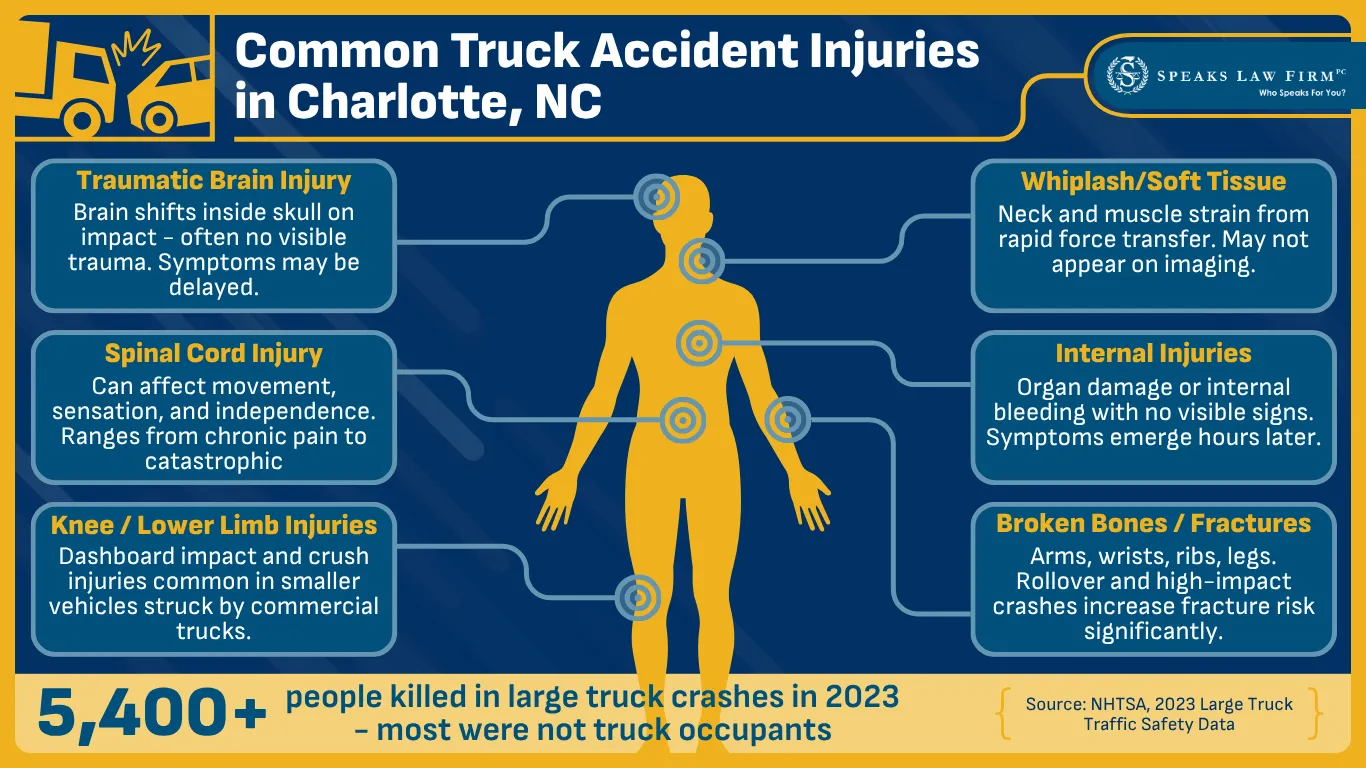
To understand why these injuries are so common, it helps to look at what makes truck accidents different from other crashes. A truck crash is not just a bigger version of a car accident. It’s an entirely different type of collision. According to NHTSA data, more than 5,400 people were killed in large truck crashes in 2023 alone, with hundreds of thousands more injured. The people most likely to die in these crashes aren’t truck drivers. They’re the occupants of smaller vehicles.
When a tractor-trailer or other commercial truck is involved, the physics alone work against you. The weight, the height, and the stopping distance all transfer force directly into the passenger compartment of a smaller vehicle. That’s why injuries in truck accidents tend to be more severe, more complex, and more likely to affect multiple areas of the body at once.
That difference in force is exactly why certain injuries show up again and again in truck accident cases.

The Most Common Truck Accident Injuries (And What They Feel Like)

You don’t experience injuries as a list. You experience them as symptoms, limitations, and disruptions to your daily life. That said, certain truck accident injuries show up again and again in Charlotte truck accident cases. Truck accident victims often don’t realize how serious their injuries are until days after the crash, and knowing what to watch for can make a real difference in how you respond.
Head Injuries and Traumatic Brain Injuries
You might not hit your head directly, and that’s what makes this type of injury so easy to miss. The CDC identifies traumatic brain injury as a leading cause of death and long-term disability in the United States, and motor vehicle crashes are among the most common causes.
The force of a truck collision can cause your brain to shift inside your skull, leading to a traumatic brain injury even without visible trauma. At first, it may feel like a dull headache that won’t go away, trouble focusing on simple tasks, or a general sense of feeling off without knowing why.
As days pass, those symptoms can intensify. Some people notice memory issues, mood changes, or difficulty sleeping. These are not minor complaints. In serious truck accident cases, traumatic brain injuries can lead to long-term cognitive challenges and significant medical expenses that stretch well beyond the initial treatment.
Spinal Cord Injuries and Back Trauma
Back pain after a truck crash is easy to dismiss at first. You tell yourself it’s soreness and try to move through it.
But when the injury involves the spine, the consequences can be far more serious. Spinal cord injuries can affect movement, sensation, and independence. Even less severe spinal injuries can produce chronic pain that interferes with work and daily life for months or years.
In more serious cases, these become catastrophic injuries that require ongoing medical treatment and create long-term financial pressure through mounting medical bills and reduced earning capacity.
Broken Bones That Disrupt Your Routine
Fractures from tractor-trailer accidents are common, but they don’t always heal quickly or cleanly. A broken wrist can keep you from working. A fractured leg can affect your ability to drive, walk, or care for your family. Rollover accidents and high-impact semi-truck accidents are particularly likely to produce multiple fractures at once.
During recovery, you may face time away from work, lost wages, physical therapy, and pain that doesn’t fully resolve on the original timeline. These injuries often become a central part of a truck accident claim, particularly when they affect your ability to return to your normal routine.
Internal Injuries You Can’t See Right Away
Some of the most dangerous injuries are the ones with no visible signs.
After a truck crash, internal bleeding or organ damage may not produce immediate symptoms. You might leave the accident scene thinking you avoided serious harm, then feel dizzy, nauseated, or weak hours later. At that point, getting medical attention quickly isn’t just about comfort. It’s about preventing further harm.
Soft Tissue Injuries That Don’t Look Serious But Are
Insurance companies often try to minimize soft tissue injuries, but if you’ve dealt with one, you know how limiting they can be.
Whiplash, muscle strain, and ligament damage can make it difficult to sit comfortably, sleep through the night, or focus at work. These injuries may not show up on imaging tests, which is exactly why they become a point of dispute in a truck accident case. The absence of visible damage doesn’t mean the injury isn’t real or isn’t affecting your life.
When Symptoms Don’t Show Up Right Away
Even when these injuries are serious, they don’t always show up right away. You may feel fine in the hours immediately following the crash. Then the next day, everything changes. Delayed symptoms are particularly common with head injuries and soft tissue damage, and dismissing early warning signs as stress or soreness can work against you later.
Pay attention to changes like increasing headaches, neck stiffness, tingling in your arms or legs, and difficulty concentrating. If something feels off, trust that instinct. Getting evaluated by a medical professional early does more than protect your health. It also creates documentation that can support your truck accident injury claim down the road.
What to Do After a Truck Accident Injury in Charlotte
Once you start noticing symptoms, the next question becomes what to do after a truck accident injury. This isn’t always obvious when symptoms are delayed and the insurance company is already calling. If you’re reading this hours or days after the crash, the steps you take now still play a major role in both your recovery and your truck accident claim.
Start by focusing on what you can control from this point forward:
- Get medical attention as soon as possible. Medical evaluations are vital because symptoms often remain hidden in the immediate aftermath of a high-impact collision. A medical evaluation creates a clear record linking your injuries to the crash.
- Follow through with all recommended medical treatment. Missed appointments or gaps in care can be used by the insurance company to argue that your injuries are not as serious as you claim.
- Request a copy of the police report. If law enforcement responded, that report can provide important details about how the accident occurred, the vehicles involved, and any initial findings about fault.
- Document your symptoms and recovery. Keep track of pain levels, limitations, and how your injuries are affecting your daily life. This helps support both your medical records and your legal claim.
- Preserve any evidence you still have access to. Photos of the accident scene, vehicle damage, skid marks, or visible injuries can still be useful, even after the fact.
- Be cautious when dealing with the insurance company. They may request a recorded statement or present an early settlement offer before you understand the full extent of your injuries. You are not required to respond immediately.
- Avoid downplaying your injuries. What you say early on can be used later. If you are still being evaluated or treated, it is reasonable to say that you do not yet know the full extent of your injuries.
As you take these steps, you may also start thinking about whether another party’s actions contributed to the crash and whether you have the right to pursue compensation under North Carolina law.
What Your Injuries Mean for a Truck Accident Claim
At some point after a truck accident, the focus shifts from figuring out what’s wrong to figuring out what to do about it. That’s where your injuries begin to shape the value and direction of your claim.
The severity of your injuries affects the cost of your medical treatment, your ability to work, your lost income, and your need for future care and future medical expenses. In more serious cases involving reckless conduct, you may also have grounds to seek compensation through a personal injury lawsuit that includes punitive damages. All of these factors work together to determine what fair compensation looks like for your specific situation.
The more thoroughly your injuries are documented, the stronger your position when dealing with insurance companies and potentially liable parties.

Why Truck Accident Cases Are More Complicated
Understanding the value of your claim also means understanding why truck accident cases are handled differently than standard car accident claims. A typical car accident might involve one driver and one insurance policy. A Charlotte truck accident case rarely works that way.
Instead, liability can extend to multiple parties, each with their own insurance company and their own incentive to shift blame:
- The truck driver
- The trucking company
- The truck owner
- Maintenance crews responsible for inspections
- The truck manufacturer, if a defect contributed to the crash
That’s what makes these cases significantly more complex than a standard car accident claim. Identifying all potentially liable parties early, and preserving evidence before it disappears, can have a direct impact on what you’re able to recover.
In more complex truck accident cases, determining what actually happened may also involve outside experts. Accident reconstruction specialists can analyze vehicle damage, skid marks, and crash dynamics, while professionals familiar with federal trucking regulations can review driver logs, inspection records, and compliance issues. These layers of analysis can play a key role in identifying how the crash occurred and which parties may be held liable.
What Investigators Often Find

In many commercial truck accidents, the crash doesn’t come out of nowhere. Investigators frequently uncover contributing factors like:
- Driver fatigue from pushing beyond legal driving limits
- Distracted driving tied to a cell phone
- Mechanical failures from poor maintenance or missed inspections
- Cargo shifts caused by improperly loaded freight
The Federal Motor Carrier Safety Administration (FMCSA) sets strict limits on how many hours a truck driver can operate a commercial vehicle, and those regulations exist specifically to keep fatigued drivers off the road. When those rules are ignored, the consequences extend well beyond a single vehicle, often triggering a chain reaction involving multiple insurance carriers and several potentially liable parties.
Once those factors are identified, the next question becomes how the law applies to your specific situation.
How North Carolina Law Can Affect Your Case
North Carolina follows a strict contributory negligence rule, meaning that if you are found even 1% at fault, you may be completely barred from recovering compensation. Understanding how this rule applies to your case is an important part of the legal process, and one that a Charlotte truck accident attorney can walk you through from the start.

When It May Be Time to Speak With a Truck Accident Lawyer
That’s where having guidance early in the process can make a difference. You don’t have to have everything figured out before you make a call to an attorney. But if any of the following apply to your situation, talking with a Charlotte truck accident attorney sooner rather than later is worth considering:
- Ongoing pain that isn’t improving
- Medical bills that are growing faster than you expected
- Time away from work with no clear end date
- Pressure from the insurance company to settle quickly
A Charlotte truck accident lawyer can evaluate your situation, identify the potentially liable parties, and take over communication with the insurance company while you focus on getting better. Most truck accident attorneys work on a contingency fee basis, meaning you pay nothing unless your case is resolved in your favor.
You may still have questions about how these cases work, especially if this is your first time dealing with a truck accident.
Frequently Asked Questions
Q: What are the most common truck accident injuries?
A: Common truck accident injuries include traumatic brain injuries, spinal cord injuries, broken bones, internal injuries, and soft tissue injuries. These injuries tend to be more severe in truck accidents due to the size and weight of commercial trucks.
Q: Can symptoms appear days after a truck accident?
A: Yes. Many truck accident injuries, including head injuries and soft tissue injuries, may not show symptoms right away. You may notice pain, headaches, or mobility issues hours or days after the crash. Getting evaluated by a medical professional as soon as possible protects both your health and your claim.
Q: How do injuries affect a truck accident claim?
A: The severity of your injuries plays a major role in your truck accident claim. They affect your medical expenses, lost income, your need for future care, and the overall value of what you may be able to recover.
Q: Who can be held liable in a truck accident?
A: Liability in truck accident cases can extend to multiple parties, including the truck driver, trucking company, truck owner, maintenance crews, or the truck manufacturer, depending on how the accident occurred and what the investigation uncovers.
Q: How long do I have to file a truck accident claim in North Carolina?
A: Under N.C. Gen. Stat. § 1-52, you generally have three years from the date of the accident to file a personal injury claim. Three years can go faster than you’d expect when you factor in time for investigation, evidence gathering, and insurance negotiations. The sooner you speak with a Charlotte truck accident lawyer, the more time your legal team has to build your case.
Q: When should I contact a Charlotte truck accident lawyer?
A: If you’re dealing with serious injuries, mounting medical bills, time away from work, or pressure from the insurance company, it’s worth reaching out sooner rather than later. A Charlotte truck accident lawyer can review your case, explain your legal options, and handle communication with insurers while you focus on recovering.
The Insurance Company Has a Team. So Should You.
You don’t have to wait until the claims process feels overwhelming before getting answers.
A serious truck accident doesn’t just affect you in the days after the crash. The medical bills, time away from work, and pressure from the insurance company can continue long after the accident occurred. At the same time, North Carolina law applies one of the strictest fault standards in the country. If you’re found even 1% at fault, you are barred from recovering any compensation.
That’s why early decisions matter.
At Speaks Law Firm, our Charlotte truck accident lawyers take a close look at what happened, identify each of the potentially liable parties, and handle communication with the insurance company on your behalf. We review your medical records, your injuries, and the full impact the crash has had on your life so you have a clear picture of where your case stands and what options you have going forward.
Our team handles truck accident cases on a contingency fee basis, meaning you pay nothing unless we recover compensation for you. Call or submit our confidential online form to schedule your FREE case review.
While you wait for your FREE consultation, we invite you to check out our podcast, Personal Injury Lawyer Podcast with American Injury Lawyer Clarke Speaks.
Who Speaks for You? We Do!